





Key Takeaways
- Influencers are taxable persons under Malaysian income tax law when earning business income.
- Brand deals, affiliate income, gifts, and appearance fees may all be taxable.
- LHDN can audit taxpayers and request documents to verify reported income, including income earned through online platforms and digital business activities; which is why clear records matter.
- Proper documentation reduces audit stress and penalty risks.
- Structuring your creator career correctly protects both income and reputation.
Influencer tax refers to income tax obligations imposed on Malaysian content creators who earn money or benefits from social media activities, including sponsorships, advertising revenue, affiliate commissions, and paid reviews. Such earnings are generally treated as business income and must be declared to the Inland Revenue Board of Malaysia (LHDN).
If you earn from YouTube ads, sponsored posts, affiliate sales, livestream gifts, or paid reviews, LHDN generally expects you to declare the income.
In many cases, creator earnings are treated as business income, but the exact tax treatment can depend on your facts, such as how regularly you do it, whether you have contracts/deliverables, and how you operate your creator activities.
Many creators are asking:
- Do I need to register a business?
- How do I declare influencer income?
- What happens if LHDN audits me?
- Are gifts and PR packages taxable?
This guide was prepared by our Accounting service team, and we hope to answer all of that clearly and practically.
Do Influencers Need to Declare Income to LHDN?
If you earn income in Malaysia, the answer is Yes, you must declare it to the relevant authority, which is the Inland Revenue Board of Malaysia (LHDN). This falls under “Profits from a business”, taxable in Malaysia.
You are likely earning business income, if you are:
- YouTuber earning AdSense
- TikToker receiving creator fund payouts
- Instagram personality doing sponsored posts
- Live seller earning commissions
- An artist or actor receiving paid review fees
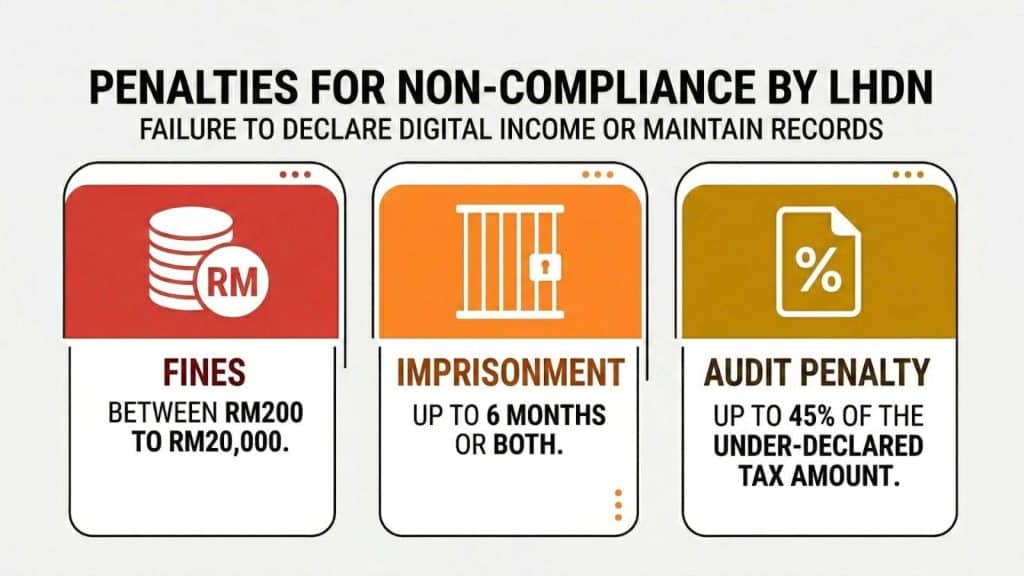
According to LHDN, failure to declare digital income or maintain records can result penalties for non-compliance as follows:
- Fines: Between RM200 to RM20,000
- Imprisonment: Up to 6 months or both
- Audit Penalty: Up to 45% of the under-declared tax amount
What is Considered Taxable Income for Influencers?
Common taxable income for influencers in Malaysia include:
- Sponsored posts & brand collaborations
- Affiliate commissions (Shopee, Lazada, TikTok Shop)
- YouTube AdSense revenue
- TikTok Creator Fund
- Live gifts converted into cash
- Appearance fees
- Paid event hosting
- Review payments
- Digital product sales
- Course or workshop fees
For Influencers Who Receive Free Products, PR Packages, and Gifts
Many influencers assume that only cash payments are taxable. Non-cash benefits may also be taxable under Malaysian tax principles if they are received in exchange for services.
For example:
If a luxury bag worth RM5,000 is provided to you specifically to promote the brand on your social media channels, the value of that item is generally treated as income-in-kind.
In other words, even though no money changed hands, you received something of value as compensation for your promotional activity.
From a tax perspective, LHDN focuses on whether the product was provided as part of a commercial arrangement.
Two common scenarios illustrate this:
1. Product given with promotional expectation
Usually taxable if a brand sends you a product with the expectation that you will:
- Post a review
- Create a sponsored video
- Mention the product in your content
- Tag or promote the brand
then the product is effectively payment for services. The fair market value of the item should be treated as part of your business income.
2. Unsolicited gifts with no obligation
Usually not taxable, if a company sends a product without any agreement, request, or expectation of promotion, and you are free to ignore it or keep it without creating content. The item is generally considered a gift rather than taxable income.
In practice, if the brand subsequently benefits from your promotion, tax authorities may interpret the arrangement as commercial in nature.
Best Practice for Influencers
To stay compliant and avoid confusion during an audit, experienced creators often:
- Keep a record of all PR packages received
- Note whether there was a contract or promotional obligation
- Estimate the fair market value of high-value items
- Maintain communication records with brands
When influencers start receiving high-value items regularly, LHDN may view these as part of their overall influencer income stream.
In short, the key question is not whether you were paid in cash — but whether you received value in exchange for promotional activity.
How to Declare Influencer Income in Malaysia
Here’s the step-by-step process.
Step 1: Determine Your Tax Status
Most influencers fall under:
- Sole proprietor (self-employed individual)
- Personal income tax filer (Form B)
If you are not employed elsewhere, you will file under Form B (business income).
Step 2: If You’re Not Yet a Registered Income Tax Payer
You may register via:
- LHDN’s MyTax e-Daftar Portal
After registration, you will receive a tax number.
Step 3: Keep Proper Records
LHDN requires records to be kept for 7 years. So be sure to maintain the following records:
- Bank statements
- Sponsorship contracts
- Platform payout reports
- Invoices issued
- Expense receipts
Step 4: Calculate Your Net Business Income
Once you have recorded all revenue from brand collaborations, advertising payouts, affiliate commissions, and other monetisation sources, the next step is to calculate your net business income.
The basic calculation formula is:
Gross Influencer Income – Allowable Business Expenses = Net Business Income (before personal tax reliefs)
In practice, many influencers overpay tax because they do not properly identify their deductible business expenses.
Under Malaysian tax principles, expenses that are “wholly and exclusively incurred in producing income” may generally be claimed as deductions.
For content creators, this includes a range of operational costs required to produce and distribute content professionally.
Step 5: Submit via e-Filing
Influencers with business income typically file Form B. For YA 2025 (filed in 2026), the official due date is 30 June 2026 (manual), with e-Filing due by 15 July 2026 (per LHDN’s filing programme).
Before submitting to LHDN’s e-Filing System, ensure all income, deductions, and supporting records are accurately prepared, to avoid penalties or audit issues.
What Happens During an LHDN Audit?
An audit by the Inland Revenue Board of Malaysia (LHDN) is a routine compliance process, not an automatic accusation of wrongdoing. Its primary goal is to verify that your reported income matches your actual earnings.
For digital creators, LHDN focuses on the accuracy of digital income streams and the legitimacy of business expenses.
Understanding influencer income tax in Malaysia is vital because earnings often come from:
- Multiple Platforms
- Sponsorships
- Affiliate Marketing
- Free Products, PR Packages, and Gifts
Documents LHDN May Request
Influencers should be prepared to provide:
- Income breakdown by platform (YouTube AdSense, TikTok Creator Fund, affiliate platforms)
- Brand collaboration agreements or sponsorship contracts
- Payment records and invoices issued to brands
- Bank statements showing incoming transfers
- Supporting documents for business expenses (receipts, software subscriptions, equipment purchases)
- Business registration documents (such as SSM registration if operating as a sole proprietor)
LHDN may also compare your declared income with publicly visible activity — such as sponsored posts, brand campaigns, or lifestyle indicators to assess whether reported earnings are reasonable.
For influencers whose income is increasing rapidly, maintaining accurate records and transparent reporting practices is the most effective way to reduce audit risk and ensure long-term compliance.
Further reading: How to Prepare Proof of Income in Malaysia: Documents & Tips
What Influencers Should Prepare Before LHDN Checks?
Influencers often receive income from multiple platforms and brand partnerships, so maintaining an organised documentation is essential for demonstrating compliance.
Proper financial record-keeping practice also allows you to manage your growing digital business more efficiently while reducing the risk of non-compliance during tax reviews.
If your influencer income begins to grow significantly — particularly above RM100,000 annually, it may be advisable to consult a tax professional regarding business structuring, tax planning, and compliance adherence.
Conclusion: From Influence to Responsibility
The era of casual, undocumented earnings is over. As digital income grows, so does regulatory responsibility. Understanding influencer tax is no longer optional — it is part of a professional brand management.
Accounting Malaysia provides expert accounting services, auditing, bookkeeping, and tax services to Malaysians who need help with income tax e-filing and preparing required documentation for LHDN.
Let our team of accounts and tax specialists assist you in remaining compliant, confident, and document-ready at all times.
FAQs About Influencer Tax
It is not mandatory for influencers to register a company at the start. Many begin as sole proprietors, which is simpler. But as income grows, registering for sole proprietorship or a Sdn Bhd may offer better liability protection and tax planning benefits.
For self-employed individuals, if your chargeable income after deductions and reliefs is below the taxable threshold (typically around RM34,000+ after EPF relief), you may not have to pay tax.
Yes. LHDN can request financial records, monitor public accounts, and cross-check banking transactions.
You may face penalties, back taxes, and fines if audited. Voluntary disclosure reduces penalty rates.
Yes. Even side income from content creation must be declared if earned.