





Key Takeaways
- Accounting for company operations should start from day one to prevent tax and financial issues later.
- Separating personal and business finances helps Malaysian businesses stay organised and compliant.
- Even freelancers and small businesses must track income, expenses, and tax obligations.
- Proper accounting systems help businesses generate financial reports like Profit & Loss, Balance Sheet, and Cash Flow.
- Malaysian Sdn Bhd companies have stricter reporting requirements compared to freelancers or sole proprietors.
Accounting for company finances means building a system to track income, expenses, taxes, and financial reports.
Many Malaysian business owners start their businesses with big dreams, but sometimes overlook proper accounting practices. Common situations include:
- Mixing personal and business money
- Losing important receipts
- Confusion about tax filing & reporting to LHDN
- Struggling to track whether the business is actually making profit
If this sounds familiar, don’t worry. You’re not alone.
Many SMEs and startups in Malaysia only start organising their accounting when tax season arrives, which can become quite “kelam-kabut”.
The truth is simple: setting up accounting early makes tax filing, financial planning, and business growth much easier.
This guide explains how Malaysian businesses can set up a simple accounting system from day one, whether you are running a Sdn Bhd company, a small shop, or working as a freelancer.
What Does “Setting Up Accounting” Actually Mean?
When we talk about accounting services for company setup, we are referring to creating a structured system to track all financial activities in a business.
This system usually records:
- Income (sales revenue, service payments)
- Expenses (rent, marketing, supplies)
- Invoices issued to customers
- Taxes payable
- Financial reports
In simple terms, accounting helps answer key business questions like:
- Are we making profit?
- Where is our money going?
- Can we afford to expand?
Why Accounting Matters For Businesses
Proper accounting is important because it supports:
- Tax compliance with the Inland Revenue Board of Malaysia (LHDN)
- Financial clarity for owners and managers
- Investor readiness for startups seeking funding
- Business growth decisions based on real financial data
Without proper accounting, even profitable businesses may face financial confusion.
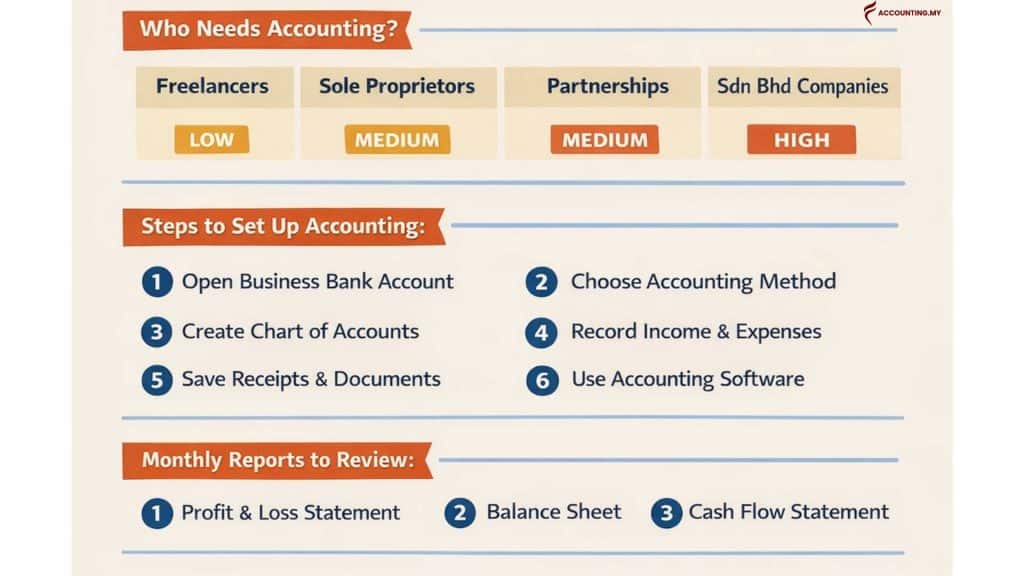
Who Needs Accounting In Malaysia?
The short answer: every business needs accounting.
However, the level of complexity differs depending on the business structure.
Accounting Complexity By Business Type
Business Type | Accounting Complexity | Example |
Freelancer | Low | Graphic designer, consultant |
Sole Proprietor | Low – Medium | Online seller, café owner |
Partnership | Medium | Marketing agency with two partners |
Sdn Bhd | Higher | Startup company or SME |
Key Differences
Freelancers and small business owners
- Mainly track income and expenses
- Prepare tax filing for LHDN
- May use simple spreadsheets
Sdn Bhd companies
- Must prepare formal financial statements
- Submit corporate tax filings
- Maintain proper accounting records
Under the Companies Act 2016, Sdn Bhd companies must keep proper accounting records for at least 7 years.
Step-By-Step: How To Set Up Accounting For A New Business
Setting up Accounting for company operations is easier when broken down into simple steps.
Step 1: Open A Separate Business Bank Account
One of the biggest mistakes new entrepreneurs make is mixing personal and business money.
This makes bookkeeping messy and complicates tax reporting.
Why This Matters
Separating accounts allows businesses to:
- Track business income accurately
- Identify deductible expenses
- Simplify financial reporting
Example
If you run a small online store:
- Customer payments go into business account
- Business expenses are paid from the same account
Your personal spending should never mix with this account.
Popular Banks Used By Malaysian SMEs
- Maybank
- CIMB
- Public Bank
- Hong Leong Bank
- RHB Bank
Many banks also offer SME business accounts with online banking tools.
Step 2: Choose An Accounting Method
Businesses typically choose between two accounting methods.
Accounting Method Comparison
Method | How It Works | Best For |
Cash Accounting | Record income when money is received | Freelancers, small businesses |
Accrual Accounting | Record income when invoice is issued | Larger businesses, Sdn Bhd |
Example
Cash Accounting
A freelancer receives RM2,000 payment today: recorded today.
Accrual Accounting
A company issues an invoice today but payment arrives next month: recorded when invoice is issued.
Most Malaysian small businesses start with cash accounting because it is simpler.
Step 3: Create A Chart Of Accounts
A Chart of Accounts is simply a list of financial categories used in accounting.
It helps businesses organise their transactions properly.
Sample Chart of Accounts
Category | Example |
Revenue | Sales income |
Expenses | Rent, marketing |
Assets | Cash, inventory |
Liabilities | Bank loans |
Equity | Owner capital |
Think of this as the filing system of your company’s finances.
Without it, transactions become messy and difficult to track.
Step 4: Start Recording Transactions
Once the system is ready, businesses should start recording transactions regularly.
This includes:
- Sales revenue
- Customer invoices
- Supplier purchases
- Expense payments
- Loan repayments
Example Scenario
A café owner records:
- Daily coffee sales
- Supplier purchases of milk and beans
- Staff wages
- Rent payments
Over time, these records form the company’s financial history.
Step 5: Save Receipts And Documents
Businesses in Malaysia must maintain financial documentation.
Typical records include:
- Invoices issued
- Receipts
- Bank statements
- Payment confirmations
- Supplier bills
These documents are important for tax audits and financial verification.
Digital Storage Is Recommended
Many businesses now scan or upload receipts to cloud storage.
Popular options include:
- Google Drive
- Dropbox
- Accounting software document storage
Keeping documents digitally helps prevent lost receipts — a very common SME problem.
Step 6: Use Accounting Software
Manual bookkeeping works in the beginning, but software makes accounting much easier.
Common Accounting Software Used In Malaysia
Software | Best For |
AutoCount | Malaysian SMEs |
SQL Account | Local businesses |
Xero | Cloud accounting |
QuickBooks | Small businesses |
Benefits Of Accounting Software
- Automatic financial reports
- Easier tax calculations
- Invoice generation
- Expense tracking
Many Malaysian companies integrate accounting software with POS systems and payment platforms.
Step 7: Review Your Financial Reports Monthly
Accounting should not only happen during tax season.
Business owners should review reports every month.
Key Reports To Check
Profit & Loss Statement
Shows business revenue and expenses.
Balance Sheet
Shows assets, liabilities, and equity.
Cash Flow Statement
Shows how money moves in and out of the business.
Monthly reviews help founders answer important questions like:
- Are we profitable?
- Are expenses increasing?
- Do we have enough cash?
This is why experienced entrepreneurs say:
“Numbers tell the real story of your business.”
Accounting Setup For Sdn Bhd Companies
Sdn Bhd companies have additional financial responsibilities.
Typical accounting requirements include:
- Preparing annual financial statements
- Filing corporate tax returns
- Maintaining proper bookkeeping records
- Reporting to company directors
Many Malaysian businesses appoint:
- Professional accountants
- Accounting firms
- Corporate secretaries
These professionals ensure compliance with:
- Companies Commission of Malaysia (SSM)
- LHDN tax regulations
Because penalties can occur if companies fail to maintain proper records.
Read more: Enterprise vs Sdn Bhd: What Malaysian Owners Must Know
Accounting Setup For Freelancers And Sole Proprietors
Freelancers usually require a simpler accounting setup.
Their main financial tracking includes:
- Income received from clients
- Business expenses
- Tax-deductible costs
Example Tools Used By Freelancers
- Excel or Google Sheets
- Invoicing apps
- Simple accounting software
The main goal is accurate income reporting for tax filing.
Many freelancers in Malaysia only realise this when filing Form B tax returns with LHDN.
Common Accounting Mistakes New Businesses Make
Many entrepreneurs unintentionally create accounting problems early on.
1. Mixing Personal And Business Money
This makes bookkeeping extremely confusing.
2. Not Tracking Expenses
Without proper expense records, businesses lose tax deductions.
3. Ignoring Bookkeeping Until Tax Season
Trying to reconstruct a year’s worth of transactions is stressful.
4. Not Saving Receipts
Without receipts, expenses may not be recognised during audits.
These mistakes often lead to tax compliance problems later.
Simple Accounting Checklist For New Malaysian Businesses
Here is a quick checklist for setting up Accounting for company finances.
✔ Open a business bank account
✔ Create a chart of accounts
✔ Start recording transactions
✔ Choose accounting software
✔ Store receipts digitally
✔ Review financial reports monthly
Following this checklist helps businesses maintain clean financial records from the start.
Conclusion
Setting up Accounting for company operations may sound complicated, but in reality it simply means creating a system to track income, expenses, and financial records.
When businesses establish proper accounting early, they gain better financial visibility, easier tax compliance, and stronger decision-making capabilities.
Good accounting practices help Malaysian entrepreneurs:
- Manage cash flow
- Stay compliant with LHDN
- Understand business profitability
- Prepare for growth and investment
If you’re unsure how to set up your accounting system, professional support can make the process much smoother. Our accounting and company secretary service help Malaysian businesses stay compliant while focusing on growth.
FAQs About Accounting For A New Company In Malaysia
Yes. Even small businesses must track income and expenses for tax reporting to the Inland Revenue Board of Malaysia (LHDN).
Yes. Freelancers must record income, expenses, and invoices to accurately report earnings when filing annual taxes.
Common options include AutoCount, SQL Account, Xero, and QuickBooks, which help businesses automate bookkeeping and generate financial reports.
A chart of accounts is a list of financial categories used to organise transactions, including revenue, expenses, assets, liabilities, and equity.
Businesses should update transactions regularly and review financial reports at least once every month.
Yes, small businesses can handle basic accounting using software or spreadsheets. However, many companies hire accountants to ensure tax compliance and financial accuracy.