




Key Takeaways
- Malaysian MSMEs can get a further 50% tax deduction on eligible AI training expenses under Budget 2026. (claimable once every two years).
- The training must be recognised by the MyMahir National AI Council for Industry, or NAICI.
- MSMEs including HRDF (HRD Corp) contributors may qualify, as long as the training and application meet the conditions.
- The effective period is for applications received by TalentCorp from 1 January 2026 to 31 December 2027.
- The real value is not just tax savings, but using practical AI training to improve day-to-day performance.
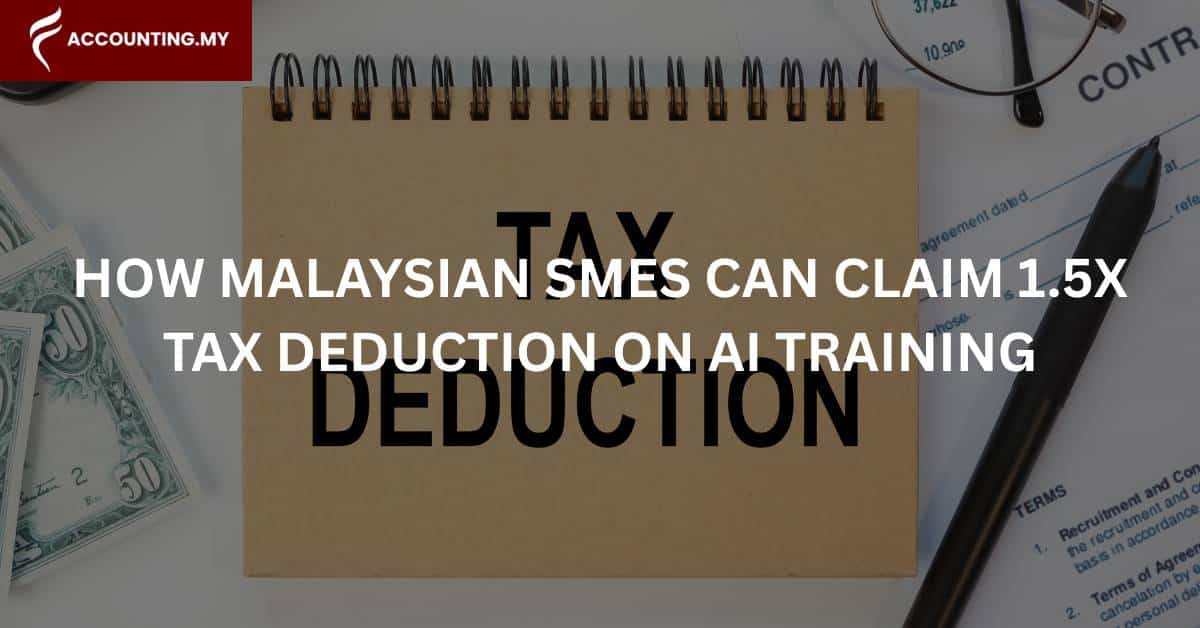
Budget 2026 gives Malaysian MSMEs a further 50% tax deduction on qualifying AI training expenses.
In simple terms, this helps reduce the cost of approved AI upskilling. It is not an upfront cash grant, and it is not a direct rebate. Instead, it improves the tax treatment of qualifying training spend.
If your SME is already planning to train staff in practical AI use, this incentive can make that investment easier to justify and our accounting service firm will teach you how.
Why Does AI Training Tax Deduction Matter So Much?
Malaysian SMEs are being pushed to do more with tighter teams, tighter margins, and more digital demands.
A lot of SMEs are already feeling the pressure:
- More admin work
- Faster reporting expectations
- E-invoicing readiness
- Rising operating costs due to global supply chain and energy-price volatility
- Higher pressure to improve productivity as competitors adopt automation and AI
AI has been touted as a way to relieve all of this pressure. For example:
- Retailers may want better demand forecasting before festive periods
- F&B operators may want to reduce waste and improve stock planning
- Finance team may want faster bank reconciliation and fewer manual checks
- Distributor may want better route planning and inventory visibility
Who Can Claim the AI Tax Deduction?
The incentive is aimed at MSMEs, including HRDF (HRD Corp) contributors, provided the training meets the government’s requirements.
The key points are:
- Training must be recognised by NAICI (MyMahir National AI Council for Industry)
- Deduction is claimable once every two years
- Effective period is for applications received by TalentCorp from 1 January 2026 to 31 December 2027
This makes the incentive especially relevant for:
- SME owners
- finance managers
- HR and L&D teams
- operations managers
- business leaders planning digitalisation efforts
How Does the 50% Further Tax Deduction Actually Work?
The easiest way to understand it is this: Qualifying AI training can receive an extra deduction layer, not just the usual business deduction.
A lot of businesses hear “50% deduction” and assume it means half the money comes back in cash. That is not how it works.
Instead, the cost becomes more tax-efficient if it qualifies.
Simple illustration
Item | Amount |
AI training spend | RM10,000 |
Normal deduction basis | RM10,000 |
Further 50% deduction | RM5,000 |
Total potential deduction basis | RM15,000 |
The final tax saving depends on the company’s tax position, but the point is this, approved training can become more worthwhile from a budgeting perspective.
What Kind of AI Training Is Most Likely to Qualify?
The safest choice is recognised, business-linked training with clear practical outcomes.
For most SMEs, that means training that helps teams actually improve workflows, decision-making, or risk management.
Stronger-fit examples | Weaker-fit examples |
AI for finance and accounting workflows | Broad AI awareness talks with no real operational use |
AI for demand forecasting and inventory planning | Hype-driven short courses with weak outcomes |
AI-assisted reporting and dashboard use | Programmes that are not recognised by relevant authorities |
Generative AI for business teams with practical use cases | Training focused only on theory without business application |
Cyber security training linked to digital operations | Generic IT or digital courses not specific to AI use |
Workflow automation for admin-heavy functions | Training with no clear link to business KPIs |
A simple rule helps here: if the course sounds impressive but does not solve your business problem, it is usually a weaker fit.
Where Can SMEs Actually Use AI in Daily Operations?
Most SMEs do not need advanced AI theory, you don’t have to be the next Elon Musk or Sam Altman.
If you are in the following industry, AI application can help you in more ways than you imagine.
Retail
Retailers can use AI training to improve:
- Demand forecasting
- Promotion planning
- Product movement analysis
- Reorder timing
That is especially useful around high-sales periods such as Raya, Chinese New Year, school holidays, and year-end campaigns.
F&B
For F&B operators, the strongest use cases often include:
- Stock planning
- Food waste reduction
- Outlet-level sales pattern tracking
- Purchasing decisions based on demand trends
Finance and accounting
Finance teams often benefit from AI in areas such as:
- Bank reconciliation
- Invoice matching
- Exception spotting
- report drafting
- Repetitive admin reduction
Logistics and distribution
In distribution-heavy businesses, AI can support:
- Route planning
- Stock movement visibility
- Reorder signals
- Demand trend interpretation
What Do SMEs Usually Get Wrong About This Incentive?
The most common mistake is assuming all training support works the same way. It does not.
SMEs often mix up:
- Tax deductions
- HRD Corp claims
- Grants
- Vendor-led promotions
- Generic “digitalisation support” messages
We like to reiterate, each works differently. Many of these incentives come with different rules as they target different outcomes.
Common mistakes to avoid
- Choosing a course before checking recognition status
- Assuming any AI-related course will qualify
- Confusing a tax deduction with direct reimbursement
- failing to keep proper records
- sending staff for training without a follow-up implementation plan
- treating AI as a trend instead of a business tool
How Should SMEs Prepare Before Claiming?
Treat this as a business improvement project, not just a training purchase.
Start with one important question: What is slowing the business down right now?
That could be:
- Sow reporting
- Repetitive finance admin
- Poor stock planning
- Weak forecasting
- Too much manual customer support
- Rising cyber security concerns
Once that is clear, the business can match the problem to the right training path.
Before committing, it helps to:
- Identify one clear operational pain point
- Check whether the programme is recognised by NAICI
- Confirm application timing and process with TalentCorp
- Keep invoices, payment records, syllabus, and attendance details
- Involve finance early
- Define one post-training implementation step within 30 to 60 days
That last point matters more than many SMEs realise. Training only creates ROI when something actually changes after the course.
HRD Corp vs Tax Deduction, What Is the Difference?
HRD Corp and tax deductions can both support training, but they are not the same tool.
Factor | HRD Corp | AI tax deduction |
Main function | Training fund / claim support | Improved tax treatment |
Benefit timing | Often earlier cash-flow relief | Realised through tax filing |
Best for | Employers managing training budgets | Businesses planning strategic upskilling |
consideration | Claim process and levy status | Recognition and tax eligibility |
When Does This Incentive Actually Become Worthwhile?
It is probably worth exploring if:
- Your team handles repetitive processes every week
- Forecasting is weak or too manual
- Reporting takes too long
- Operations rely too heavily on spreadsheets and manual checks
- Management wants efficiency gains without immediate headcount growth
It is probably not the first priority if:
- There is no clear use case
- No one internally will implement what is learned (happens more times than you think)
- The training is too generic
- The team is treating AI as a gimmick.
Why the AI Tax Deduction Matters for Malaysian SMEs
AI training, when chosen correctly, can help SMEs reduce manual work, improve decision-making, and keep up with increasing operational demands.
At the same time, not every business will qualify automatically, and not every training programme will meet the requirements. That is where proper planning and guidance become important.
If you are unsure where to start, Accounting.my can help you:
- Assess whether your business is eligible for AI training tax incentives
- Identify suitable, recognised training pathways
- Audit your expenses properly for LHDN compliance
- Align training with business use cases
If you are planning to explore AI training or want to understand how it fits into your business operations and tax planning, this is the right time to do it properly, and our audit services are always ready to serve your business!
Source:
- Malaysia Ministry of Finance (MOF) — Belanjawan 2026: Tax Measures (PDF) (11 Oct 2025).
- Malaysia Ministry of Finance (MOF) — Belanjawan 2026 Budget Speech (English) (PDF) (10 Oct 2025).
- Jabatan Penerangan Malaysia (JDN) — Press Release: Allocations in Belanjawan MADANI 2026 set to spur Malaysia’s digital transformation (PDF) (11 Oct 2025).
- The Star — Budget 2026: SMEs to get 50% tax deduction for AI and cybersecurity training (10 Oct 2025).
- Skrine — Tax measures under the 2026 Malaysian Budget (17 Oct 2025).
- EY Malaysia — Take 5: Budget 2026 (PDF) (10 Oct 2025).
Frequently Asked Questions About Tax Deduction on AI Training
It is a Budget 2026 measure that gives Malaysian MSMEs a further 50% tax deduction on qualifying AI training expenses, subject to the government’s conditions.
It improves the deductibility of qualifying AI training costs. It is not a direct cash payout, but a tax incentive applied through the company’s tax treatment.
Because eligible AI training must be recognised by the MyMahir National AI Council for Industry, which is a key requirement for the incentive.
Yes, this incentive can still be relevant to MSMEs that contribute to HRD Corp, depending on the qualifying conditions.
Usually not. The stronger fit is recognised training with clear business relevance and practical outcomes for the company.
They should confirm recognition status, keep proper records, involve finance early, and connect the training clearly to business operations and expected results.