





Key Takeaways
- ESOS allows employees to buy company shares at a predetermined price.
- Tax is triggered when the option is exercised, not when shares are sold.
- The taxable benefit is classified as a perquisite under Malaysian tax law.
- Employees, not employers, are generally taxed when ESOS is exercised.
- Planning ahead helps you choose when to exercise your ESOS so you can avoid a bigger-than-expected tax bill.
ESOS (Employee Share Option Scheme) is a compensation programme that gives employees the right to purchase company shares at a predetermined price in the future. When employees exercise these options and acquire shares below market value, the difference is treated as a taxable perquisite under Malaysian income tax rules administered by LHDN.
Employee benefits are evolving across Malaysian companies, especially among startups, tech firms, and growing SMEs. To retain talent, one of the most attractive incentives used to retain talent is ESOS.
However, many employees and even employers misunderstand the tax implications under LHDN, leading to unexpected tax bills and compliance issues. This is where professional accounting services play a vital role, to ensure your ESOS programme is planned correctly and that all filings are accurate.
If you are an employee considering exercising your share options — or a business owner implementing the programme, understanding the tax rules in Malaysia is essential before making any decision.
Understanding the Employee Share Option Scheme (ESOS)
ESOS is commonly used by companies to align employee interests with company performance.
Instead of simply paying cash bonuses, employers grant employees the right (but not obligation) to buy company shares later at a fixed price.
This price is called the exercise price or option price.
If the company’s value increases over time, employees can buy the shares at the lower price and potentially benefit from the difference.
Why do companies implement ESOS?
Companies in Malaysia often introduce ESOS programmes to:
- Retain key employees
- Encourage long-term commitment
- Align employee incentives with company growth
- Reward performance without immediate cash outflow
- Attract top talent in competitive industries
For startups and growing SMEs, ESOS can be a powerful compensation strategy when cash resources are limited.
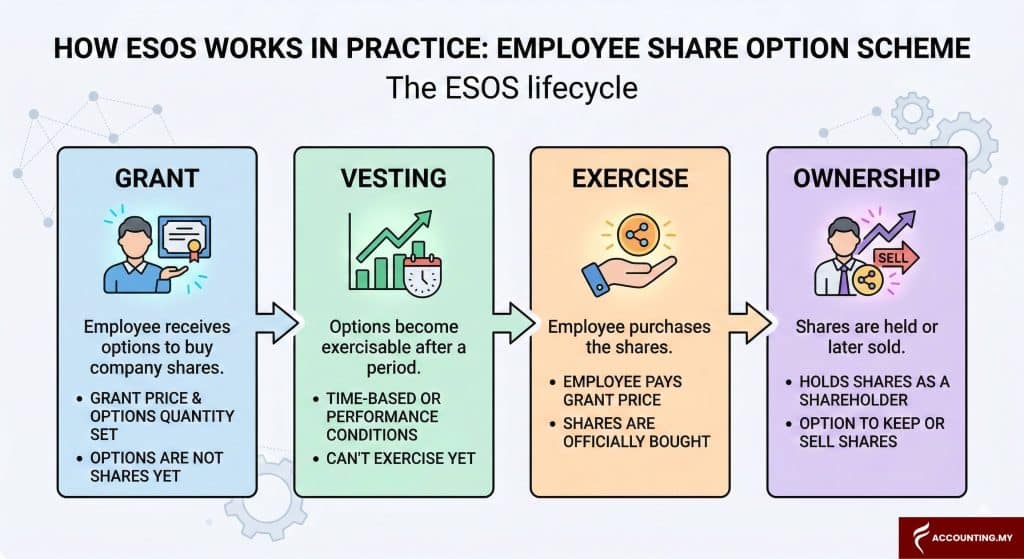
This diagram illustrates the progression of a standard ESOS lifecycle, from the initial grant to final ownership:
- Grant: The start of the process, where an employee receives options to purchase shares at a future date.
- Vesting: The period where the options mature and become available to the employee, often linked to service time or performance goals.
- Exercise: The action where the employee pays the grant price to officially convert their options into company shares.
- Ownership: The final stage, where the employee holds the shares and has the choice to keep them or sell them in the future.
Example:
Stage | Share Price | Employee: Sarah’s Action | Cash Impact |
Grant | RM1.00 | Signs ESOS agreement | RM0 |
Vesting | RM3.00 | Continues working | RM0 |
Exercise | RM5.00 | Buys 10k shares at RM1 | -RM10,000 |
Sale | RM5.00 | Sells 10k shares at RM5 | +RM50,000 |
Net Gain | +RM40,000 |
The LHDN Tax Trap: When Is ESOS Taxed?
One of the most misunderstood aspects of ESOS taxation in Malaysia is when the tax is triggered.
Under Malaysian tax rules administered by LHDN (Inland Revenue Board of Malaysia), tax is usually triggered when the option is exercised, not when the shares are sold.
This surprises many employees. They assume tax applies only after selling the shares and receiving cash.
However, LHDN considers the benefit received when buying shares below market value as income.
The Legal Term: Perquisite
In Malaysian tax law, the benefit from ESOS is classified as a perquisite.
A perquisite refers to a non-cash benefit or benefits-in-kind provided by an employer that is treated as taxable employment income.
This means the gain from ESOS exercise must be declared as employment income.
Examples of other traditional perquisites include:
- Company cars for personal use
- Housing benefits
- Petrol cards for personal use
How ESOS Tax Is Calculated in Malaysia
The taxable amount is determined based on the difference between the market value of the shares and the price paid by the employee.
The Formula
Taxable amount = (Market value) – (Price you paid)
Real-World Example
Let’s assume the following scenario:
Item | Amount |
Number of shares | 5,000 |
Exercise price | RM2 |
Market value at exercise | RM8 |
Step 1: Calculate gain per share
RM8 – RM2 = RM6
Step 2: Multiply by number of shares
RM6 × 5,000 shares = RM30,000
Taxable income = RM30,000
The RM30,000 is treated as employment income, which will be taxed based on the employee’s individual income tax rate.
Who Pays Tax When ESOS Is Exercised?
A common question among Malaysian business owners and employees is — who is responsible for the tax?
In most cases:
- Employees are the taxpayers
- The benefit is treated as employment income
- Employers may be required to report the perquisite in EA forms
Employer responsibilities
Companies implementing ESOS must:
- Record ESOS benefits correctly
- Report them in employee income statements
- Ensure compliance with payroll reporting
- Maintain proper documentation
Failure to report ESOS benefits properly may expose companies to LHDN audit risks.
When Should Employees Exercise Their ESOS?
Timing can significantly affect tax outcomes. Employees often ask whether they should exercise earlier or later.
The decision usually depends on several factors. So consider exercising ESOS when:
- Share value growth appears sustainable: Exercising too early may limit potential gains.
- Your tax bracket is manageable: A large ESOS exercise could push you into a higher tax bracket.
- You have liquidity for tax obligations: Tax may be payable even if shares are not sold.
- Company exit or IPO is expected: Many employees wait for liquidity events.
Choosing the right time to exercise can help you reduce the tax impact while still giving your shares more chance to grow in value.
How ESOS Benefits Employees
Despite the tax implications, ESOS remains one of the most attractive compensation benefits. For many employees in Malaysia, ESOS has been a pathway to substantial financial gains.
Key advantages include:
- Wealth creation opportunities: Employees can participate in the company’s growth.
- Long-term financial upside: If the business performs well, ESOS can generate significant gains.
- Alignment with company success: Employees feel more invested in company performance.
- Career incentives: High-performing employees often receive larger option allocations.
Conclusion: Plan Before Exercising Your ESOS
ESOS can be a powerful wealth-building opportunity and for retaining talent for key employees, but exercising it without understanding the tax implications under LHDN can lead to unexpected financial consequences.
For Malaysian SMEs and corporate employers, proper ESOS implementation requires transparent payroll reporting, tax compliance, and proper documentation.
This is where professional tax services become essential.
If your company is considering implementing an ESOS programme, or if you need help understanding the tax compliance, payroll and perquisite reporting, Our team of accounts professionals can assist you.
Contact us for a quick consultation today.
Source
- LHDN tax case index showing ‘Badges of Trade’ cases
- IRBM (LHDN) Public Ruling No. 11/2012 – Employee Share Scheme Benefit
Supports the treatment of ESS/ESOS benefits as employment income and the valuation rule using the market value on the date the right is exercisable or exercised, whichever is lower. - IRBM (LHDN) Public Ruling No. 4/2004 – Employee Share Option Scheme Benefit
Supports the general tax treatment of ESOS benefits and employee reporting obligations. - IRBM (LHDN) Public Ruling No. 5/2019 – Perquisites From Employment
Supports the statement that ESOS/ESS benefits are treated as perquisites under employment income rules. - IRBM (LHDN) Form EA (C.P.8A)
Supports the point that employers generally need to report relevant employment income, including ESOS benefit, in the employee’s EA form.
Frequently Asked Questions About ESOS in Malaysia
Yes. When employees exercise ESOS, the difference between market value and exercise price is treated as a taxable perquisite under LHDN rules.
Usually no additional tax applies on the sale of shares because Malaysia does not impose capital gains tax on most share disposals. The tax occurs at exercise.
However, the sale of shares may also be taxable depending on your situation. From 1st March 2024, LHDN imposed Capital Gains Tax (CGT) on gains/profits from the disposal of shares in unlisted Malaysian-incorporated companies, subject to the CGT rules and exemptions.
Employers can design ESOS schemes carefully, but tax rules are determined by LHDN guidelines, so professional tax planning is recommended.
No. Private companies and startups in Malaysia can also implement ESOS programmes, especially for senior management and early employees.
Unvested options are usually forfeited. Vested options may remain exercisable within a limited period depending on the company’s ESOS rules.
Yes. Employers are generally required to declare ESOS benefits as employment income in the employee’s EA form for tax reporting purposes.