




Import tax is a mandatory charge imposed by the Royal Malaysian Customs Department (RMCD) on goods entering Malaysia.
It serves two main purposes:
- Protect local industries
- Generate national revenue
If you have ever seen a parcel marked “Held by Customs”, it usually means one of two things:
- Documentation verification
- Tax payment required
Whether you are:
- Ordering small items from overseas marketplaces
- Running an SME importing bulk inventory
- Bringing in machinery or specialty goods
Understanding the 2026 tax rules prevents costly delays and surprise bills, so let our accounting firm explain what you should know before buying or importing stuff in Malaysia.
Common Import Tax Rates
Item Category | Import Duty | Sales Tax (SST) | Notes |
Online Goods < RM500 | 0% | 10% | LVG rule applies |
Computers & Phones | 0% | 5% | Laptops, tablets, smartphones |
Clothing & Fashion | 0–20% | 10% | Depends on HS Code |
Luxury Cars (Langkawi) | Exempt* | Exempt* | Only if < RM300,000 |
Alcohol & Tobacco | High | 10% | Plus heavy excise duty |
Always verify classification before purchase.
How Malaysian Customs Calculates Your Tax
Malaysia uses different bases depending on whether you’re dealing with LVG or a standard import:
Standard imports
Customs valuation commonly considers the total landed value, which can include CIF (cost + insurance + freight)—so freight/insurance may affect duties and taxes.
Landed Cost = CIF + Import Duty + SST + Excise (if any) + Courier Fees
LVG (≤ RM500) sales tax
RMCD states the 10% sales tax is charged on the sale value of LVG, excluding charges like transportation/insurance/other costs.
Example
You buy:
- Watch price: RM600
- Shipping: RM100
Taxable value becomes RM700, not RM600.
Scenario: Importing a Boutique Coffee Machine
You import an espresso machine valued at RM2,000 CIF.
Step 1: Import Duty (10%)
RM2,000 × 10% = RM200
Step 2: SST (10%)
Calculated on RM2,200 (CIF + Duty)
RM2,200 × 10% = RM220
Total Tax Payable: RM420
Important: SST is applied after import duty. This “tax on tax” structure often surprises first-time importers.
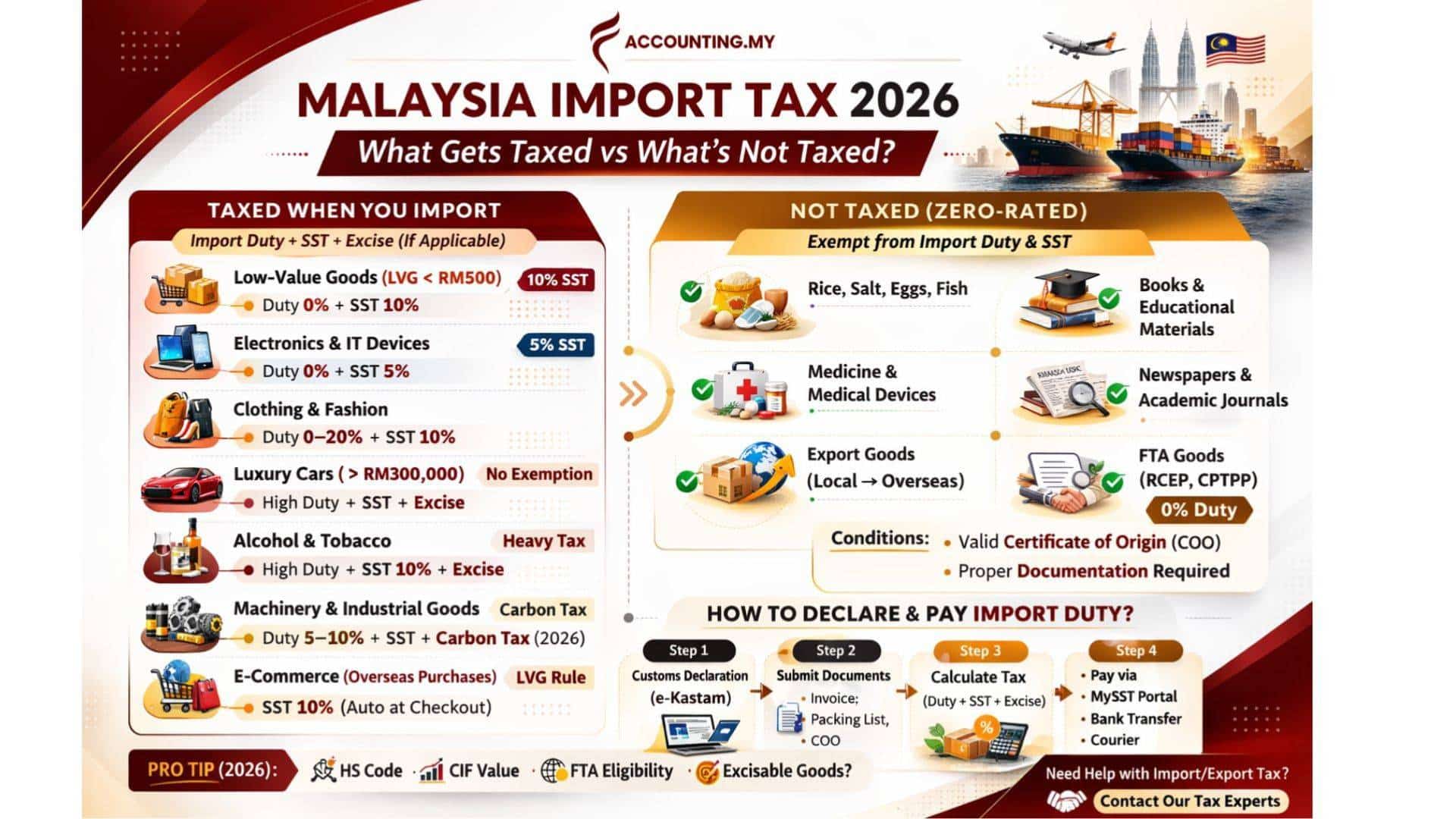
What Exactly Gets Taxed When You Import?
Many Malaysians assume everything imported is taxed the same way. That is not true. Import charges depend on three key factors:
- The type of product (HS Code classification)
- The CIF value (Cost + Insurance + Freight)
- Whether the item qualifies for an exemption or FTA rate
Let’s break this down clearly.
1. Low-Value Goods (LVG): Small Online Purchases
If you buy from overseas and the item’s CIF value is below RM500:
- Import Duty: 0%
- Sales Tax (SST): 10%
- Paid automatically at checkout on most platforms
This applies to:
- Fashion items
- Gadgets
- Beauty products
- Home accessories
Important distinction: You are exempt from import duty, not from sales tax. The 10% LVG SST still applies. Alcohol and tobacco are excluded and subject to heavier taxation.
2. Electronics and IT Equipment
Most consumer electronics enjoy favorable duty rates.
Generally Low or Zero Import Duty:
- Laptops
- Smartphones
- Tablets
- Computer components
Sales Tax:
- Usually 5% for IT-related devices
Malaysia keeps these rates lower to encourage digital adoption and technology access.
However, accessories such as premium headphones or certain peripherals may fall under different HS codes, which changes the rate.
3. Clothing, Fashion and Textiles
This is where variation becomes significant.
Import Duty can range from:
- 0% for some categories
- Up to 20% for certain fabrics or finished garments
Sales Tax remains:
- 10% standard rate
Why the difference?
Textile classification depends on:
- Material composition
- Country of origin
- Product finishing
A cotton T-shirt and a luxury leather jacket may fall into entirely different duty brackets.
4. Luxury Vehicles and Special Zones
Langkawi and Labuan historically offered vehicle tax exemptions. In 2026:
- Exemption applies only to vehicles valued under RM300,000
- Higher value vehicles no longer enjoy full exemption
Outside duty-free zones:
- Import Duty can be very high
- Excise Duty applies
- Sales Tax applies
Luxury cars are among the most heavily taxed imported items in Malaysia.
5. Alcohol and Tobacco
These fall under excisable goods and face layered taxation:
- High import duty
- 10% Sales Tax
- Heavy excise duty
Excise duty is calculated differently and often significantly increases total cost.
For example: A bottle priced at RM150 overseas can easily exceed RM300 after all duties and excise are applied.
What Is NOT Taxed (Or Zero-Rated)?
Malaysia maintains an exemption framework to protect essential living standards.
Essential Food Items
Generally exempt from SST and often import duty:
- Rice
- Salt
- Eggs
- Certain fresh local fish species
These policies help stabilize food prices.
Printed Educational Materials
What is zero-rated:
- Printed books
- Newspapers
- Academic journals
Digital publications, however, may not enjoy the same treatment.
Medical and Health Aids
Selected medical devices and therapeutic aids qualify for exemption, including:
- Certain medical support products
- Specific therapeutic devices
- Approved assistive equipment
Always verify classification because medical “wellness” products do not automatically qualify.
Goods Covered Under Free Trade Agreements (FTA)
If imported from partner countries under:
- RCEP
- CPTPP
You may qualify for:
- 0% import duty
But only if you provide:
- Proper Certificate of Origin
Without documentation, standard duty applies.
Common Misconceptions About Import Tax
“If it’s a gift, I don’t pay tax.”
Incorrect. If CIF exceeds RM500, tax applies regardless of whether it is a gift or purchase.
“If shipping is free, tax is lower.”
Not necessarily. If the seller bundles shipping into product cost, CIF still reflects the true transaction value.
“If it’s below RM500, no tax at all.”
Wrong. No import duty, yes but the 10% LVG Sales Tax still applies.
Rule of Thumb Before Importing
Before importing, ask:
- What is the HS Code?
- What is the CIF value?
- Does an FTA apply?
- Is it excisable (alcohol, tobacco, vehicles)?
If unsure, budget an extra 10–15% of the landed cost to stay safe.
How to Legally Reduce Import Tax in
Reducing tax is about compliance and planning, not manipulation.
Use Free Trade Agreements (FTAs)
Malaysia participates in:
- RCEP
- CPTPP
Goods from countries like China, Japan, and Australia may qualify for 0% duty if supported by a Certificate of Origin.
Without proper documentation, you lose the preferential rate.
Licensed Manufacturing Warehouse (LMW)
For manufacturers exporting finished goods:
- Raw materials can be imported tax-free
- SST payment deferred
- Improved cash flow
This is especially relevant for SMEs in electronics, automotive components, and precision engineering.
Verify the HS Code
A single-digit misclassification can change:
- 0% duty → 15% duty
- No license required → Import permit required
Always confirm classification before shipment.
How to Declare and Pay Import Duty in Malaysia
Paying import duty is not complicated, but the process differs depending on if you are an individual buyer or a registered business.
For Individuals Buying Online
If you purchase goods from overseas marketplaces:
- The seller or platform calculates the 10% LVG Sales Tax at checkout for items under RM500.
- The courier handles customs declaration on your behalf.
- If additional duty applies, the courier will notify you before delivery.
- You must pay the amount before the parcel is released.
Payment is usually made through:
- Online banking link provided by courier
- Credit or debit card
- Cash on delivery in some cases
Common couriers that handle this process include DHL, FedEx, Ninja Van, and Pos Malaysia.
If your parcel is marked “Held by Customs,” check your email or SMS for a payment request.
For Businesses and Commercial Importers
Commercial importers must declare goods through the e-Kastam system.
The process involves:
- Preparing a commercial invoice
- Identifying the correct HS Code
- Calculating CIF value
- Submitting declaration electronically
- Paying assessed duty and SST
- Awaiting release confirmation
Most SMEs appoint:
- A licensed customs broker
- A freight forwarding agent
to handle submission and clearance.
Payment is made electronically via:
- e-Kastam payment gateway
- Approved banking channels
Goods are only released after payment is confirmed.
Documents Required for Import Declaration
Whether personal or commercial, customs may request:
- Commercial invoice
- Packing list
- Bill of lading or airway bill
- Certificate of Origin (if claiming FTA)
- Import permit (if required)
Missing documents are one of the main causes of clearance delay.
What Happens If You Disagree With the Tax Assessment?
If you believe customs assessed the wrong value or HS Code:
- You may request a reassessment
- Submit supporting documents
- Provide proof of transaction value
Do not ignore the notice.
Failure to respond may result in storage charges or seizure.
Timeline for Clearance
Clearance timeframes:
- Clean personal shipment: 1 to 3 working days
- Commercial shipment with full documentation: 1 to 5 working days
- Shipments requiring permits or inspection: Longer
Delays increase warehousing or demurrage costs.
Conclusion: Import Tax Is a Cost, Compliance, and Strategy Issue
Import tax in Malaysia is no longer just about paying 10% and moving on. It affects landed cost calculations, pricing strategy and cash flow planning.
If your business imports stock, raw materials, machinery, or exports finished goods, tax compliance should not be reactive.
At Accounting.my, our tax services help SMEs and businesses:
- Determine correct HS classifications before shipment
- Calculate accurate landed cost projections
- Import transactions for better cash flow planning
- Review FTA eligibility and documentation
- Align customs declarations with SST filings
- Minimise audit risk through proper digital recordkeeping
If your business deals with cross-border trade, speak to our advisors to build a compliant, cost-efficient import and export tax strategy that protects your margins and keeps customs clearance smooth!